Earlier Short Stories!
Creative Note & Disclaimer: The narratives below are works of creative fiction written with the assistance of generative AI. While these short stories are inspired by a personal interest in Native American cultures, history, and spiritual connections to nature, the specific characters, dialogue, traditions, and plot lines are entirely AI-generated. They do not represent official historical records, authentic oral traditions, or lived experiences of any specific Indigenous nation.
Because Native American history is incredibly diverse—comprising hundreds of distinct Sovereign Nations with unique cultures—readers are strongly encouraged to seek out authentic voices. To learn real history directly from Indigenous communities, please visit official repositories such as the National Museum of the American Indian, the Cherokee Nation, or the Navajo Nation Government.
A little instrumental Native American
 |  |  |  |
|---|---|---|---|
 |  |  |  |
 |  |  |  |
 |  |  |  |
 |  |  |
The Digital Barrier
The "digital barrier" on the Navajo Nation refers to the profound lack of high-speed broadband, cellular connectivity, and digital infrastructure across its 27,000-square-mile territory. This isolation limits access to telemedicine, remote education, and economic development. A young Navajo college student studying computer science finds an old, encrypted journal in their late grandfather’s footlocker. The grandfather was a renowned World War II Navajo Code Talker who used his native tongue to save lives in the Pacific.

The Shadow Over the Herd
The Sheep Is Life (Diné Bi’e’ena’). The devastating Livestock Reduction Era of the 1930s. Fearing that grazing herds would worsen the Dust Bowl's erosion, the U.S. government forced Navajo herders to cull roughly 250,000+ sheep and goats. The severe reductions stripped the community of their primary economic and cultural foundation. A young woman fights to hide a small herd of Navajo Churro sheep in a hidden canyon. The narrative explores her deep spiritual connection to the animals—which provide wool, food, and identity—and her quiet resistance against federal agents to save her family's way of life.

The Perfect Order
In this famous story, the Holy People (such as the Black God, the god of fire) were meticulously placing the stars in the night sky to create constellations. They designed them perfectly to serve as a calendar, a map, and a moral guide for humans.
Coyote’s Action: Coyote grew highly impatient watching this slow process. He blew out his breath or grabbed the remaining bag of stars and scattered them wildly across the sky.
The Lesson: This act created the disordered band of stars known as the Milky Way. Because of Coyote’s impatience, many stars lack names or order, meaning humans must map their own paths through life.ss of the night sky, the people must find a way to navigate their lives.

The Disruption of Balance
The Concept of Hózhó, Hózhó is the most important word in the Navajo language and is loosely translated as peace, balance, beauty and harmony. To be “in Hózhó” is to be at one with and a part of the world around you. It means striving to maintain balance, harmony, and order in all aspects of one's physical, emotional, and spiritual life.

The Accident of Two Worlds
A young Navajo artist or weaver returns home to the reservation after spending years in an urban center like Phoenix or Albuquerque. They struggle to reconcile the modern world with traditional teachings. The protagonist learns the art of the traditional loom from an elder. As they weave the pattern of a sacred mountain (such as Dook'o'oosliid / San Francisco Peaks), they realize the loom connects the Earth to the sky and find their place within their clan.
The Circle of Life
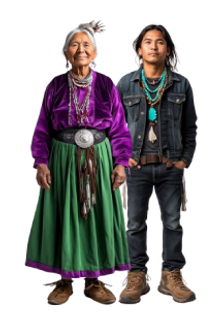
The circle of life is a concept describing the continuous, interconnected cycle of birth, growth, reproduction, and death shared by all living organisms. When viewed through the lens of the Native American medicine wheel it is an unending sacred hoop that offers a framework of the Seven Stages of Life.

The Trickster’s Choice (How Coyote Stole Fire)
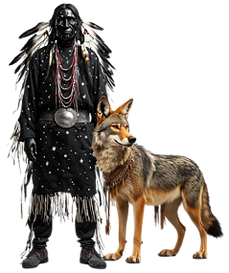
In Navajo mythology, Coyote - the central trickster - stole fire from the Fire God (Black God) to help humans survive freezing winters. Coyote sneaked up the mountain and devised a plan to snatch the flame, often described as lowering the fire or tying a bundle of wood to his tail.
.png)
The Long Walk
The Long Walk of the Navajo was the brutal, forced deportation of the Navajo (Diné) people by the U.S. government between 1864 and 1866. Approximately 10,000 men, women, and children were forced to walk up to 450 miles from their ancestral homelands to the barren Bosque Redondo Reservation in eastern New Mexico.
.png)
The Gift of the Weaver
Spider Woman (Naʼashjéʼii Asdzáá) is a revered, benevolent holy being in Navajo cosmology. She acts as a teacher, protector, and guide who gifted humanity the sacred arts of weaving and agriculture. According to legend, she resides on Spider Rock in Canyon de Chelly, Arizona.
Spider Woman’s most enduring legacy is teaching the Navajo ancestors how to spin yarn and weave on the loom. According to the traditional narrative, she provided the first loom, constructed from sacred materials:
-
The cross-poles: Made of sky and earth cords.
-
The warp sticks: Composed of sun rays.
-
The healds: Made of rock crystal and sheet lightning.
-
The batten: Made of a sun halo.
-
The comb: Fashioned from white shell.
.png)
The Accident of Pride
The "accident of pride" in Navajo (Diné) tradition refers to the famous story of the Separation of the Sexes. First Man (Áłtsé Hastiin) and First Woman (Áłtsé Asdzą́ą́) allowed their pride and an argument over who was more essential to the community to split the world into two separate camps.

The Emergence into the Glittering World
In the Navajo (Diné) creation story, the Glittering World (Nohokáá' Disxǫs) is the fifth and current world. The proto-humans and Holy People ascended into this radiant, beautiful world from the preceding Black, Blue, Yellow, and White underworlds through a magic reed. The emergence into the Glittering World represents the establishment of humanity and the natural balance of life.

The Trail of the Whispered Truths
In Navajo tradition, the phrase "Trail of the Whispered Truths" most closely refers to the spiritual teachings of the wind and the oral history surrounding the tragic Long Walk of the Navajo.
In Navajo tradition, the wind is a sacred messenger. It carries prayers to the heavens, brings warnings of change, and reminds people that they are deeply connected to nature rather than above it. Silence is also deeply respected as the place where "truth gathers strength" and where one can listen to the ancestors and their whispered truth.

The Sacred Breath of the Ancestors
In Navajo (Diné) tradition, the breath is a profound symbol of life, representing the vital wind and spirit (níłch'i) bestowed by the Creator. The first sacred cry of a newborn and the prayers of elders connect generations, embodying the resilience and spiritual continuity of the ancestors.
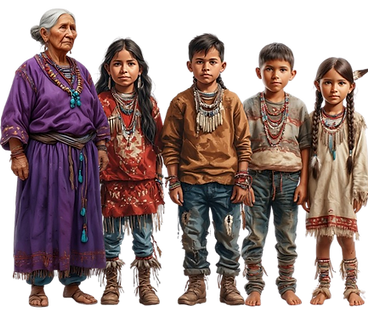
The rhythmic beat of the hand-drum echoes through the warm air, inviting the young ones to gather close. Beneath the vast embrace of Father Sky, a revered elder sits ready to share the sacred history of the Diné. She holds the wisdom of generations, using the classroom of the Earth to feed the roots of the children's minds.

The Sky’s Breath and the Earth’s Bloom
The phrase "The Sky's Breath and the Earth's Bloom" captures the essence of the Navajo (Diné) cosmic philosophy, which views existence as a sacred partnership between Father Sky (Yádiłhił) and Mother Earth (Nahasdzaan). Father Sky provides the breath, wind, and rain, while Mother Earth gives birth to and nourishes all living things
This story follows a wise Elder, Grandmother Tsosie, as she leads a group of children through the high desert. She teaches them that the world is not just a place to live, but a living family where every rain cloud is a message and every flower is a response.
The Wind at the Beginning
In Navajo (Diné) creation stories, the wind is not just a weather phenomenon, but the very essence of life, thought, and movement. Known as Níłch’i or the Holy Wind, it is the foundational spirit that arose through darkness to bring breath, speech, and purpose to the Holy People.
This is a story about a grandfather, an oral storyteller, who wants his granddaughter to understand that everything holds a living spirit, such as the water, the mountains, etc. and humans are deeply connected through the very air they breathe.
.png)
The Map of Spark and Shadow
Native Americans pass down stories from generation to generation as oral storytelling. Elders carry decades of living, witnessing, and surviving. In addition, they also share stories, and religious rites passed from the memories of one generation to the next through the spoken word. This story is about an elder grandmother who is sharing a star story with her grandchildren.
A grandmother sits with her young grandchildren outside on a clear night away from the city lights, looking directly up at the night sky. The elder points out the constellations and shares traditional "star stories" of how their people used the stars for seasonal navigation, agriculture, and agricultural timing, highlighting how history and scientific observation have been practiced by Indigenous communities since time immemorial.

The Heartbeat of the Wood
The phrase "The Heartbeat of the Wood" likely refers to the deep connection between natural timber and indigenous cultures, often expressed through drumming or craftsmanship. It also represents modern appreciation for the natural world and the sustainable harvesting of wood.
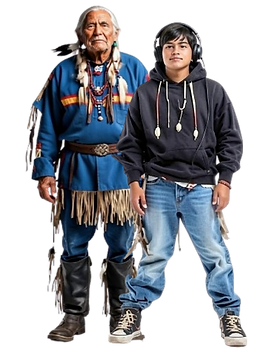
This is about a rebellious youth who expresses disinterest in traditional gatherings, preferring his modern music headphones. A wise grandfather shares the history of a family drum, recounting the generations of hands that have played it and explaining how the rhythm ties the community together across time and space.
Grandfather’s Sacred Story
The Navajo creation myth is a story told by the Native American Navajo people about their origins which serves as part of the cultural identity of the Navajo people. It is the story of a journey through four worlds of the first Navajo, or Diné, people as they came to be humans on Earth.

The Voice of the Seven Stars
Awinita struggles with self-doubt and critical inner voices represented by Grey Wolf. White Wolf symbolizes her inner wisdom and kindness, offering a calming presence. Her journey involves recognizing and feeding her positive inner voice to find balance. She learns that inner harmony requires acknowledging both her shadow and light.

The Trial of the Four Elements
Some cultures, like the Ojibwe, believe wolves are the guardians who ensure a safe journey from the material world to the spiritual one. This story follows Wulfee, a celestial guardian in the form of a White Wolf, who acts as a psychopomp for souls transitioning between worlds. He discovers Elias, a man who doesn't realize he has died, and leads him through the Trials of the Four Elements. The journey serves as a spiritual purification, turning earthly grief into starlight. already begun.

The Song of the Paws
This story reflects the Navajo (Diné) tradition, where Father Sky and Mother Earth create balance by bringing life to the world. The silver wolf serves as a messenger, connecting the celestial and terrestrial realms to maintain harmony.
In the Beginning, the World was a silent, grey stone. Father Sky and Mother Earth look down upon the emptiness and feel a deep, cold ache. They dream of a world that breathes. They need a voice to bridge the distance between the clouds and the soil. So, they call call upon a silver wolf pup to run the "First Path," turning the grey void into a playground of color and light. This is the journey of how every leaf, ripple, and breeze finds its name through the touch of a paw.

The Four Seasons of the Soul
The Four Seasons of the Soul follows the lifelong journey of Mia and Leo as they experience the cyclical, symbolic nature of life, aging, and deep friendship. The story flows through a vibrant childhood, transitions into a mature adulthood of shared, quiet wisdom, and culminates in a final, peaceful reflection on a life well-lived.
A beautiful, allegorical journey through time, using the changing landscape to mirror the aging process with grace and "snowy" peace. This story follows a single soul through the cycles of time, personified through the changing earth and the elements.
.png)
The Language of the Wind
This is a story about "Clairaudience," where a young girl learns that the whistling wind (Father Sky) is actually the ancestors whispering encouragement and direction. It centers on her discovery that the high-pitched whistles and low rumbles of the wind, often personified as Father Sky, are actually the rhythmic whispers of her ancestors. Instead of mere weather, she begins to recognize specific tones of encouragement, warnings of shifting seasons, and direct guidance for her path. It is an intimate, sensory-heavy narrative that transforms the "whistling" wind into a purposeful conversation between the living and those who came before.

The Light on the Path
In Navajo tradition, the wolf (mai-coh) is strongly associated with spiritual transitions, stamina in facing the end of a cycle, and protection. There are several specific cultural realities regarding this space: Life & Rebirth: The wolf is recognized as a guide that helps one face the end of a physical cycle with dignity and courage.
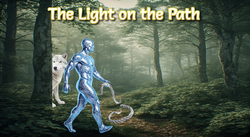
The Lesson: Transition isn't an ending; it’s a guided walk home. Just as the Wolf knows the forest, our ancestors know the way to the stars. We are never truly traveling into the unknown.
.png)
The Girl Who Listened
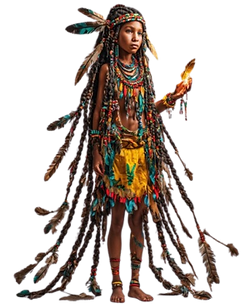
A young girl with long braids (like the figure you've seen) sits in a forest. She realizes that Mother Earth isn't just a planet, but a mother who "nurtures every aspect of life". She learns to "hear" the stories written in the stones and the "songs" carried by the wind (Father Sky).
The Lesson: This can educate on mindfulness and the importance of listening to the environment, showing that "all of nature is in us".

The Digital Pulse of the Plains
In a world that has forgotten the "Old Ways," a lone Wolf carries a Red Tie (symbolizing a bridge to the modern world) to a mentor who is creating digital stories. The Wolf shows the mentor that by sharing these tales, they are keeping the "heartbeat of the ancestors" alive for future generations.
The Lesson: This can teach the value of cultural preservation and the idea that wisdom "flows in the blood" and can never truly be lost.



Welcome to .....